How to Pick on Guitar (Even When You’re Not Shredding): One Technique, Endless Possibilities
Jan 26, 2026
If you’ve followed me on Youtube for a while, you know I spend a lot of time talking about guitar posture and what your fretting hand is up to. That’s not because picking doesn’t matter—it’s because most of the emails I get start with something like, “My hand hurts,” or “I can’t reach this stretch,” or “Why does everything feel tense?” The left hand tends to scream first when something’s off.
So talking about picking can feel a little like walking onto Troy Grady’s home turf. The guy is brilliant. He’s built an entire career around picking mechanics, and deservedly so. If you want to go deep into the physics of edge picking and escape motions, his work is required viewing.
But that’s not really the question I want to tackle today. Players often ask things like “How should I hold a pick?”, “Should I use downstrokes or alternate picking?”, and “What’s the best picking technique for clean, consistent playing?”
The real question is: how should you pick on guitar when you’re not shredding?
Because let’s be honest—most of your playing life probably isn’t spent ripping through sixteenth-note lines at 180 BPM. It’s spent on riffs, melodies, fills, and familiar songs you’ve played a hundred times. And if you’re anything like me, those are the moments where the weird little mistakes show up.
My own road to “figuring this out” has been anything but straight. I took about six months of lessons when I first started, then spent years teaching myself. I managed to earn myself some early repetitive stress injuries along the way. When I went back to school, I studied under three different guitar teachers. And even now, after all of that, I’m still refining how I approach the instrument.
One of the biggest traps in self-teaching is options. We live in a golden age of guitar content. There are thousands of YouTube videos, courses, and Instagram clips, all showing you a slightly different way to hold the pick, angle the wrist, or attack the string. It’s inspiring—and paralyzing.
Because mastery isn’t about collecting dozens of techniques like trading cards. It’s about having one solid technique you can use in dozens of ways.
This really hit me when I noticed something strange in my own playing. If you’ve ever Googled “why do I keep missing notes on guitar?” or “how to improve picking accuracy,” this part will feel familiar. I’d sit down to play a song I knew well (one of my own, usually), and every time I’d trip up—but in a different place. One day it would be the second verse. The next day it would be the turnaround. Nothing consistent.
So I started paying attention to my picking hand.
What I found was that I almost never picked the same melodic phrase the same way twice. Sometimes I’d start with a downstroke, sometimes an upstroke. Sometimes I’d “wing it” and hope my hand figured it out in real time. And that’s the problem: if nothing is repeatable, nothing is really practice. It’s just rolling the dice and seeing what happens.
That sent me looking for what I jokingly called “one technique to rule them all.” Something I could lean on most of the time, so that when I did need a special approach, it actually stood out.
The answer didn’t come from a blazing solo or some exotic picking exercise. It came from strumming.
Think about how you learned to strum. Chances are, at some point, someone told you to keep your hand moving in a steady down-up motion. Downstrokes land on the beat. Upstrokes fill in the space between the beats. If you want a different rhythm, you don’t change the motion—you just miss the strings at certain moments.
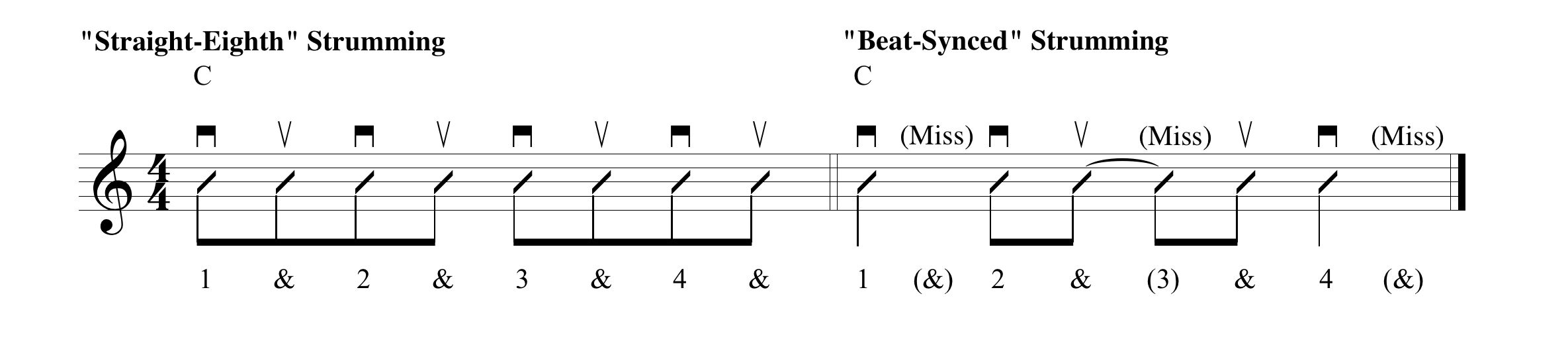
That’s a powerful idea.
Because that same concept works for melody. You just make the motion smaller.
Instead of a big, loose arc across all six strings, you’ve got a compact, controlled motion over one or two. The engine is the same: a steady, alternating down-up movement. The music happens in which strokes actually touch the string.
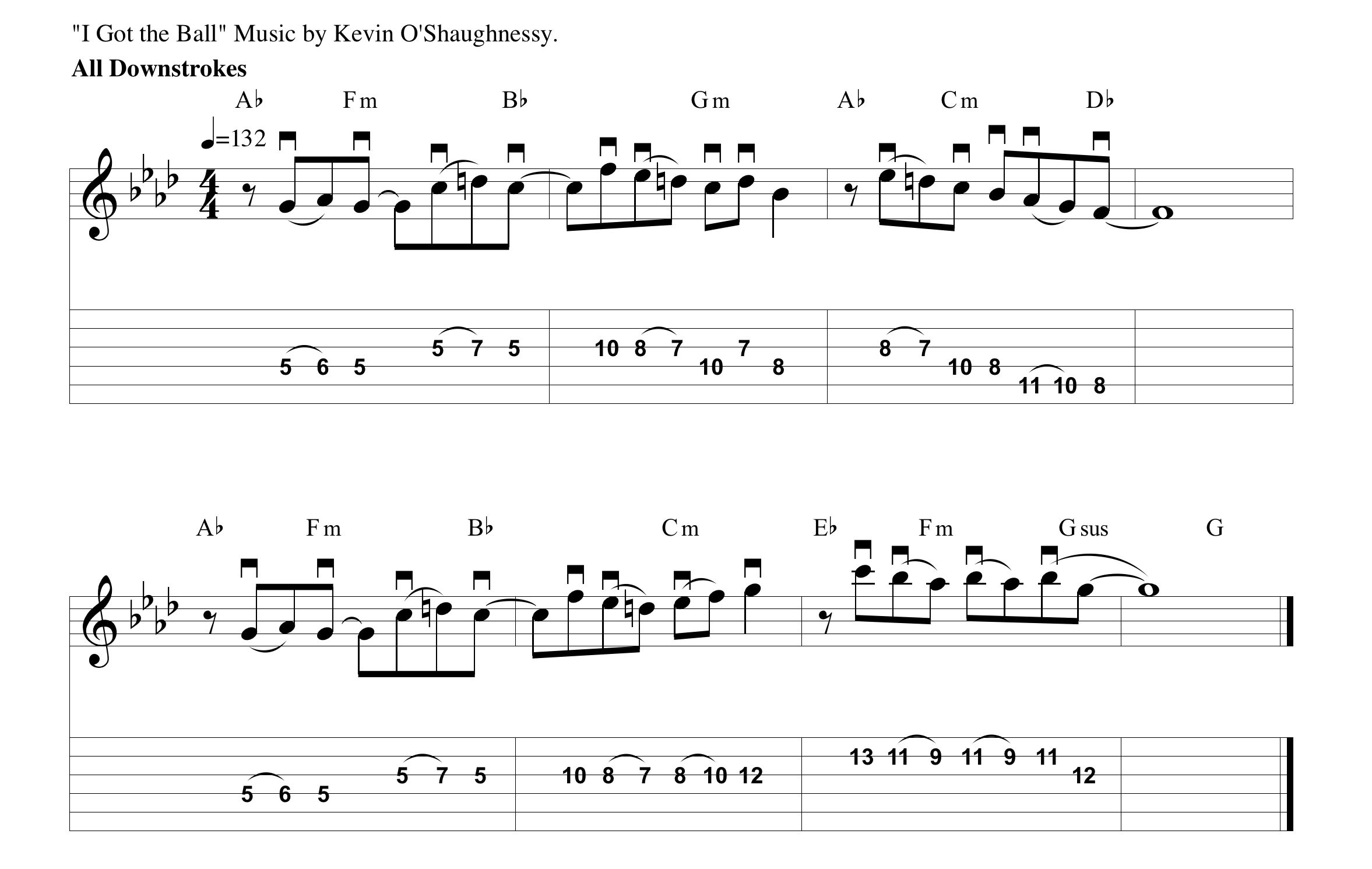
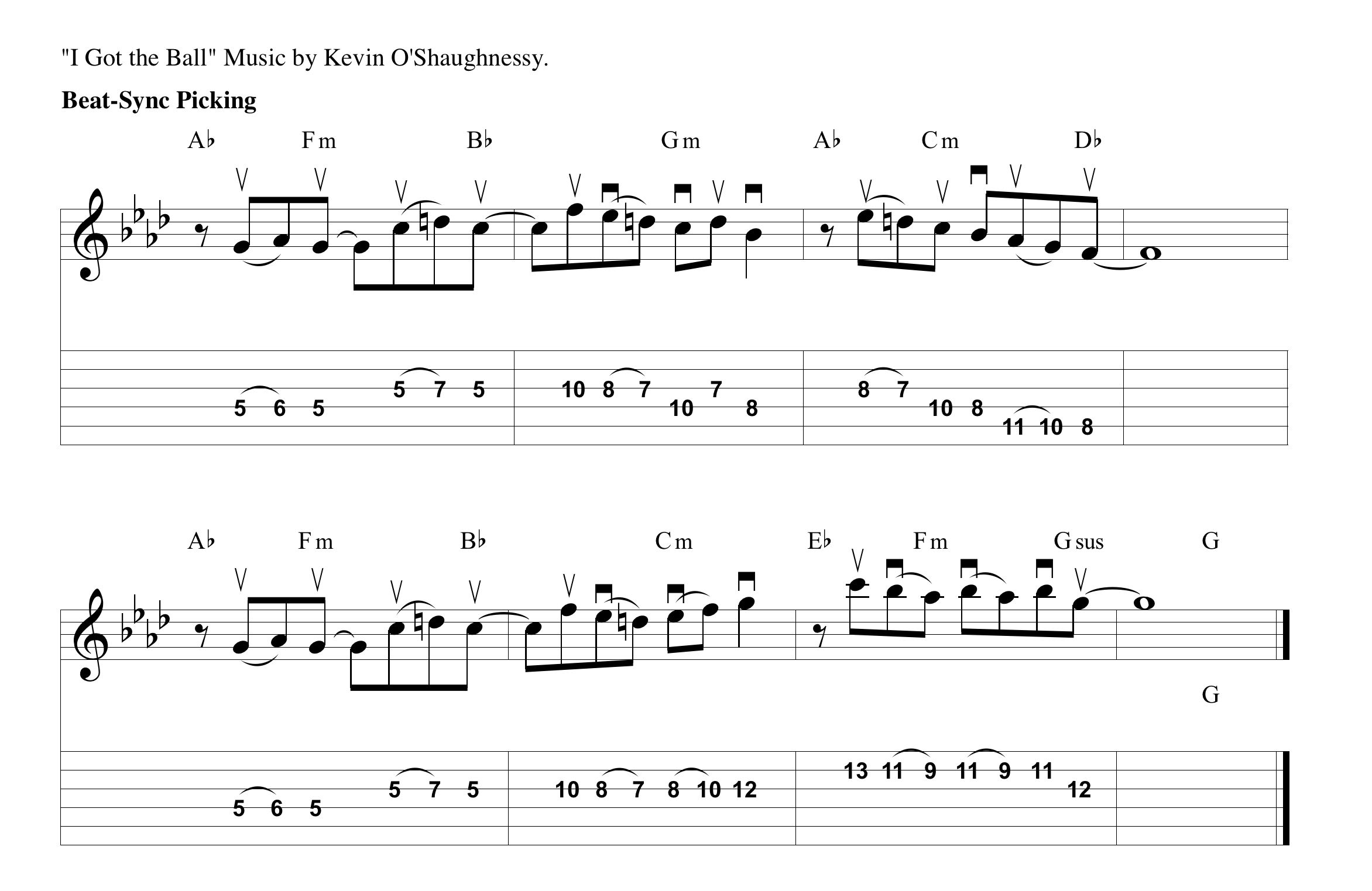
Take a look at this example from my song, “I Got the Ball”. The first version is written in all downstrokes, the second using what I call beat-synced alternate picking. The picking of the phrase is slow enough that either one is easy to play. But the second version allows me to switch to a strumming pattern or a shredding pattern with greater ease because I’m using the same technique for all three.
This isn’t some secret I stumbled onto in a basement. It’s been hiding in plain sight for decades. Berklee’s Guitar Method teaches it. Hal Leonard’s books teach it. Plenty of traditional method courses do.
But if you’re self-taught and living on a diet of random tutorials and clips, there’s a good chance no one ever sat you down and said, “Hey, this is the default. This is home base.”
At this point, you might be thinking, “Why does this matter? If I can play the part with all downstrokes, who cares?” This is where understanding the difference between downstrokes vs. alternate picking really pays off.
And you’re right—sometimes you absolutely need to use only downstrokes. Certain riffs demand it. Certain feels depend on it.
The reason this matters is bigger than any single passage. It’s about connecting a lot of different musical jobs to one physical idea.
Strumming is large-movement alternate picking.
Shredding is small-movement alternate picking.
If your everyday melodic playing also lives in that same alternate-picking world, then most of what your right hand does comes from one core technique. That means less mental juggling and more actual music-making.
When you sit down to practice, you’re not just running notes—you’re reinforcing a repeatable pattern. You can plan how you’re going to pick a phrase, stick to it, and actually measure whether it’s getting better.
And when a line really does call for something different—straight downstrokes, a sweep, a rake—it stands out as a deliberate choice, not a habit you fell into by accident.
It's also really easy to fall into bad habits without realizing it. That's what happened to me. I learned this technique decades ago. But in recent years, bad habits began to creep in. Because I'd practiced this technique, it took no time to diagnose my problem and reset.
That’s been my experience, and it’s been a good one. If you’re serious about improving your guitar picking technique, this simple shift can make your practice sessions more focused and far more productive.
Try treating your picking hand the way you treat your strumming hand: keep it moving, keep it simple, and let the music happen in the moments where you choose to connect with the strings.
You might be surprised how much closer that gets you to what we all want in the first place—playing that feels a little more effortless, and a lot more musical.