Simple Sign Posts for Learning the Fretboard
May 12, 2026
If you’re like many of my students over the years then you’ve likely had the experience of feeling lost about the fretboard. You may have even felt that you didn’t need to learn the notes as long as you had tab.
BUT… if you’re like many of my students over the years, then you’ve likely hit a wall at some point. That may have been improvising, music theory, songwriting, or any number of skills.
The truth is, music is made with notes not fret numbers.
And while it is possible to play exceptionally well without learning the fretboard, the players that can usually have an insane amount of drive and all the time in the world to find their way through trial and error.
If that’s you, awesome! Seriously. Whatever keeps you playing is what I’m interested in.
But if you want to get past some road blocks in your playing, learning the fretboard can’t hurt.
So here is a simple way to start learning the fretboard.
First, a quick description of how notes are named. Basically, we use the letter names: A, B, C, D, E, F, and G. These are the white keys on a piano.
Then we have what I like to call “switch hitters”. Technically, they’re call “accidentals” and they are the black keys on the piano. These are the sharps and flats in music and they are the notes that make it possible to play in different keys.
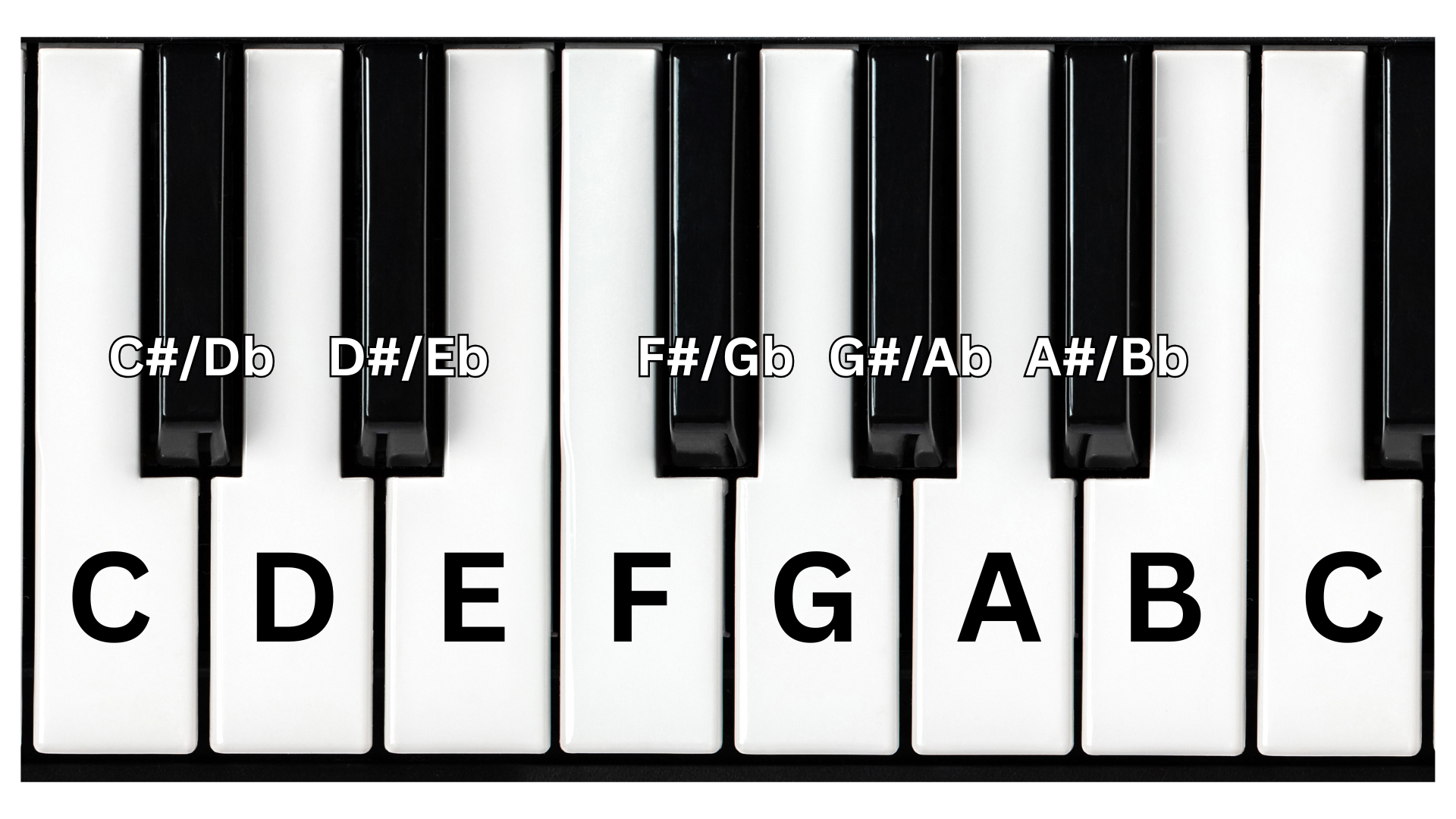
There is a reason why the notes are laid out this way but it’s a little beyond the scope of this lesson. For now, just remember the notes, A-G.
The secret to learning the fretboard is the redundancy of the notes. On a guitar, there are many places to sound the exact same note, unlike the piano which has one key per note (that’s why there are 88 keys on a piano).
So, we can take the note names of the strings (E, A, D, G, B, E), and use them like sign posts along the neck.
The simplest reference point is the 12th fret. All of the string names are repeated at the 12th fret and sound one octave higher. This means that all of the frets from the 12th fret up will have the same letter names as the frets from the open strings to the 11th fret.
So once you learn the first 11 frets, simply “copy and paste” at the 12th fret and you know those note names too.
The second reference point is the fifth fret using relative tuning. If you’re not familiar with this process, it’s where we “tune the guitar to itself”.
Play the 6th string at the 5th fret and you get an A. Using the 6th string as a reference, you can tune the 5th string so that they match. Continue on according to this diagram and the guitar will be “in tune”.
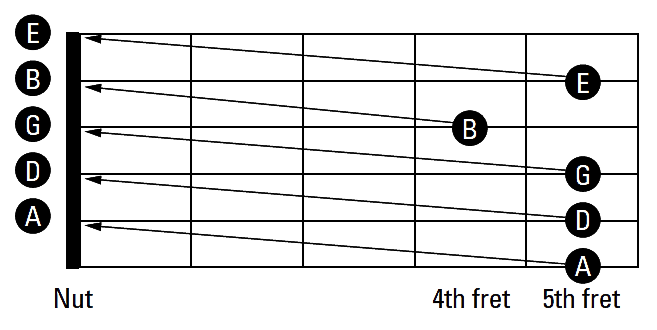
Obviously, if you’re playing with an ensemble or a recording you’ll need to tune the 6th string first. If you’re playing on your own, this will sound perfectly fine on its own.
Now you know the notes at the 5th fret: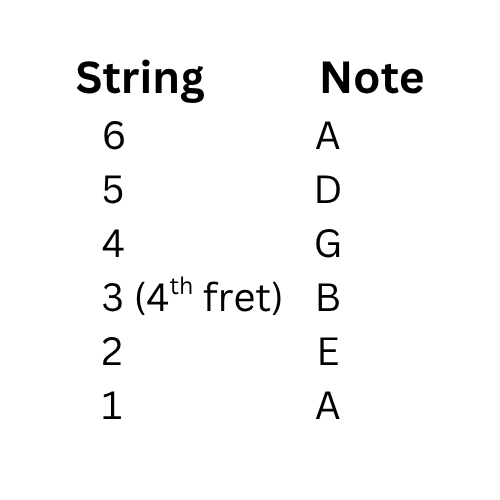
And as you can see, whatever is done on the low E string is repeated on the high E so the 5th fret is also A.
Now put it into practice
As you’re playing songs, identify what notes you can from these reference points. Here are a couple of ideas:
- If you’re playing open chords, name the open strings in each chord. the C chord uses the open G and E strings. Now you know that the C chord contains the notes C, E, and G.
- If you’re playing licks at or around the 5th or 12th frets, name the notes of the lick that fall on those frets. If you’re playing “Black Dog” by Led Zeppelin, the second note of the riff falls on the 4th string, 5th fret, which we now know is a G. The opening of “Sweet Child o’ Mine” begins on the 4th string, 12th fret, which is D.
Which other notes can you name?