How to Switch Strings Cleanly: A Smarter Picking Hand Technique for Smoother Guitar Playing
Feb 02, 2026
If you struggle to move from one string to the next because the heel of your picking hand feels glued to the bridge, your string changes will always fight you. Anchoring can add a sense of stability, but it often comes at the cost of mobility. The result? Inconsistent picking, missed notes, and performances that feel sloppier than they need to be.
If that sounds familiar, keep reading. Even seasoned players are often surprised by how much cleaner and more controlled their technique becomes with a few small adjustments to how the picking hand moves.
Efficient string switching is really about two main movements: the wrist, which strikes the string, and the elbow, which guides your hand to the correct string. Most players think everything happens at the wrist. It doesn’t.
Yes, the elbow matters. Think of it like the tonearm on a record player. Each string is a different track, and the pick is the needle. The wrist handles the fine detail of the note, but the elbow helps position the whole system over the right “track.”
Let’s break it down, starting with the wrist.
To attack the string, use a side-to-side wrist motion known as deviation. Because of how your hand is oriented on the guitar, this shows up as an up-and-down movement. That’s where your upstrokes and downstrokes come from.
The key here is continuity. After each downstroke, let the wrist rebound naturally, like a basketball hitting the floor. I like to do this in time with the music, which ties directly into the “beat-synced picking” concept I’ve mentioned in earlier lessons.
Now let’s bring in the elbow.
The elbow’s job is to move your hand across the strings. You don’t need to force the pick to travel in a perfectly straight line across the pickups. You can, but it’s not required.
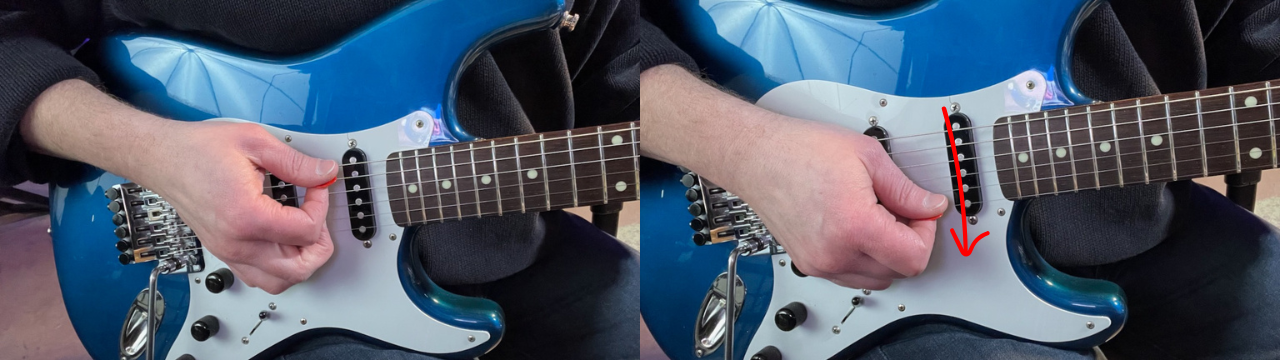
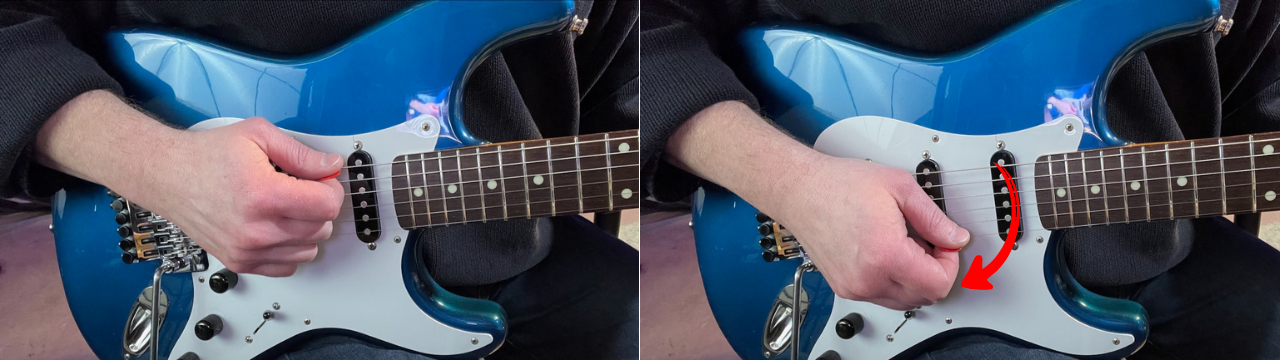
It’s completely fine—and often more natural—for the pick’s path to curve slightly. That means your hand will sit a little closer to the neck when you’re on the low E string, and a little closer to the bridge when you’re on the high E.
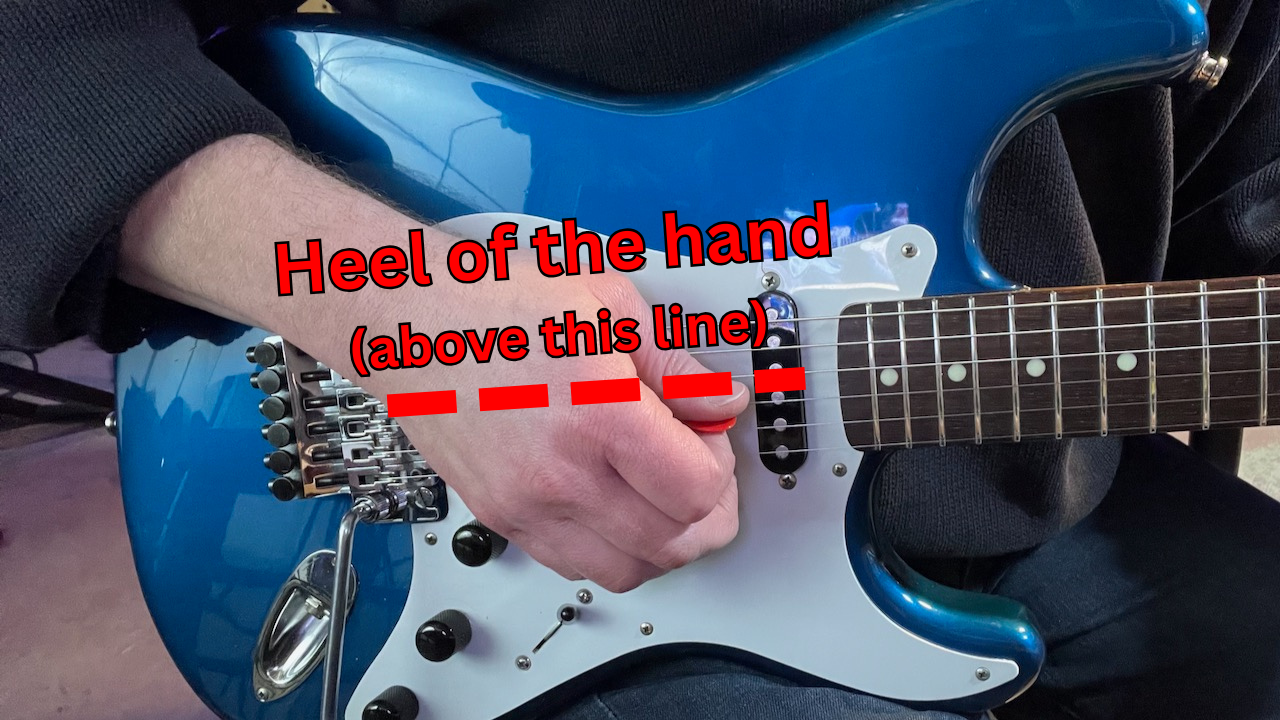
So what about the heel of the hand?
The heel should make only light contact with the strings. Pressing down too hard can unintentionally mute them and kill your tone. Ideally, it should only touch the strings that are physically above the one you’re picking, acting as gentle, controlled muting rather than a fixed anchor point.
When you put this all together, the big joints handle the big movements, and the small joints handle the fine motor work. That division of labor is what allows you to move smoothly and confidently from string to string.
It will feel strange at first. You might even sound worse before you sound better. That’s normal. Stick with it, make small adjustments as you notice tension or inconsistency, and keep things relaxed.
Before long, your picking hand will feel less tied to the bridge, your string changes will smooth out, and your lead lines will start to sound more fluid, expressive, and intentional.