Simple Sign Posts for Learning the Fretboard - Part 2
Jun 01, 2026
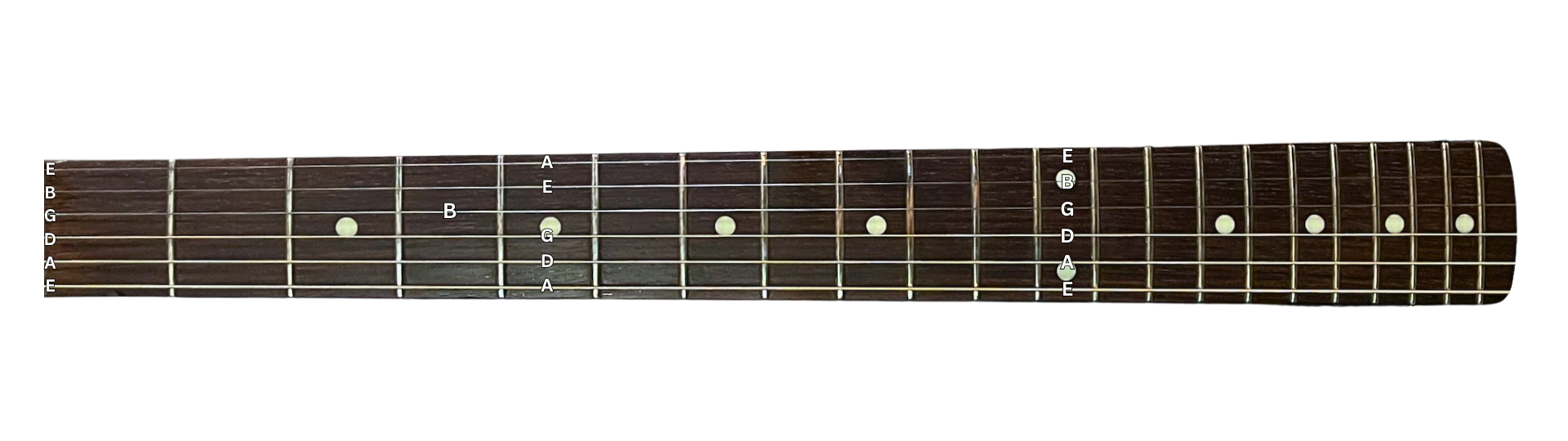
I talked in a previous post about how to use the names of the open strings on the guitar as sign posts to help unlock the note names all over the fretboard. If you haven't read that lesson yet you can check it out here.
That approach is just the starting point as it only tells us where to find five of the available twelve notes. In this lesson we're going to learn two more notes and once added, we'll be able to use them to find all of the natural notes on the fretboard.
If you've done the work from the last lesson, you should have memorized these notes on the fretboard.
Going back to the piano keyboard we can see that most of the white keys (natural notes) have a black key (accidental) in between them. But there are two pairs of notes--B and C, and E and F--that do not have a black key in between. Those pairs of notes are said to be a half step apart while the other white keys are a whole step apart.
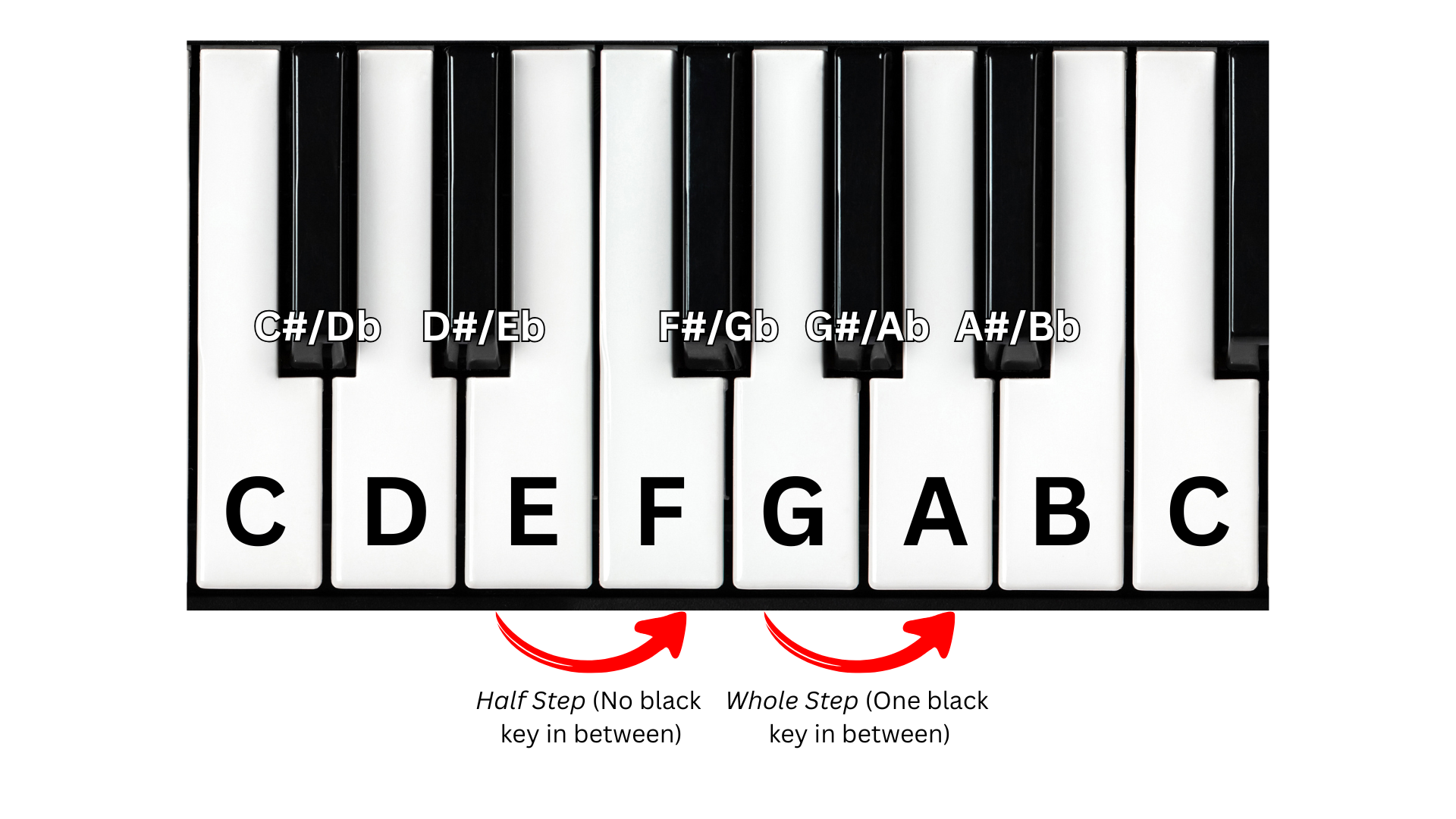
On the guitar, a half step is a distance of one fret, and the whole step is two.
If we apply the B/C and E/F patterns to the fretboard, we get this:
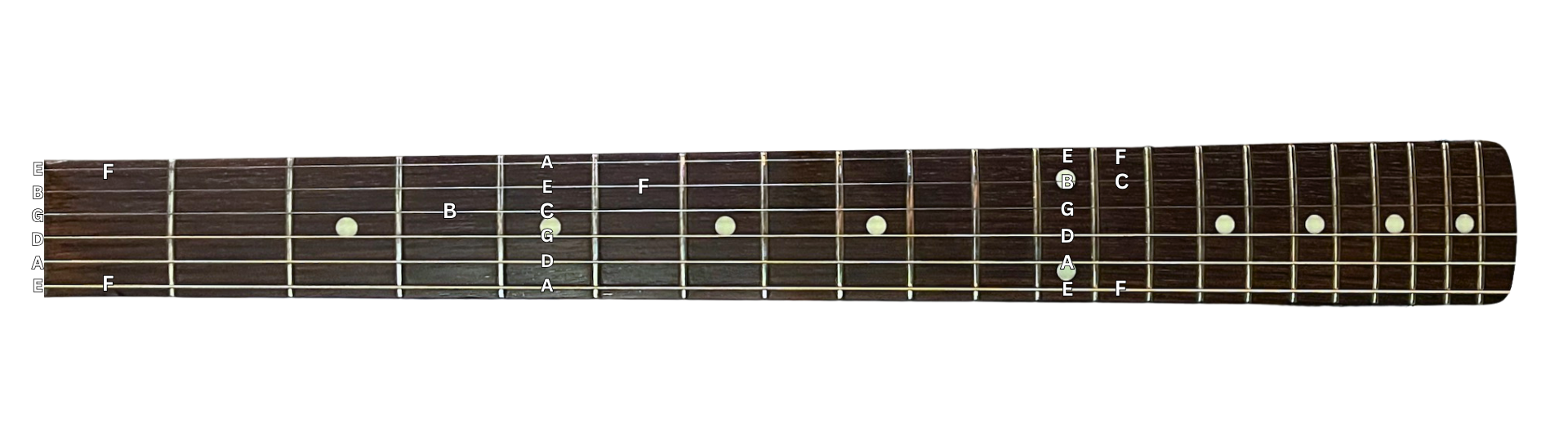
The remaining notes--A to B, C to D, D to E, F to G, and G to A--are all a whole step (two frets) apart.
Since A is the start of the alphabet, and we have an open A string, let's apply that pattern and see what we get:
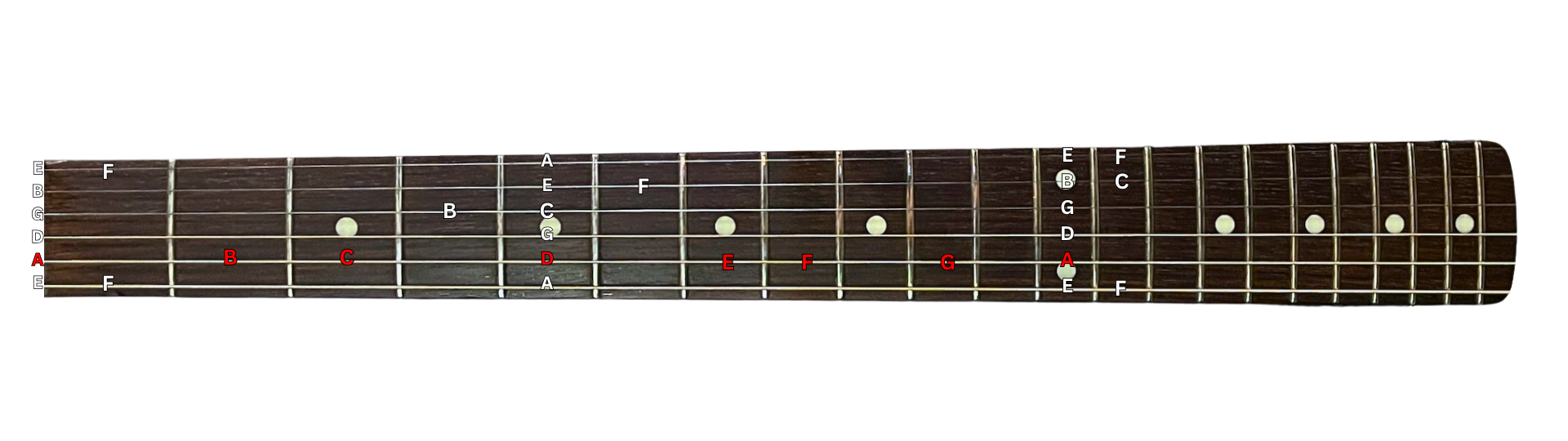
Notice that from the open A string, B is two frets away. C is one fret from B, and so on.
Now it can become a little bit of a crossword puzzle. Take this pattern of notes (which makes up the A minor scale) and apply them anywhere there's an A, or anywhere you see a B/C or E/F pairing. With these sign posts, you can make your way over the entire neck.
In truth, it's not enough to be able to "work this out". The notes on the fretboard need to be fully memorized if they are to be useful.
Your favorite players my claim not to know the notes on the fretboard (but I suspect they have some method of working around that). What they do have though is imagination, patience, time, and the drive to invent things through trial and error. If that's you, fantastic.
If that's not you, then I encourage you to take these exercises seriously. Many online instructors will tell you learning the notes on the fretboard is unnecessary. But if you're not satisfied with your playing (like me, back in the day), then this knowledge may provide the sign posts to help you get to where you want to go. It certainly helped me.