Simple Sign Posts for Learning the Fretboard - Part 3
Jun 22, 2026
In previous lessons, we mapped out the natural notes on the fretboard using the string names and applying the half step/whole step formula to the neck.
In this lesson we'll add the final piece: the accidentals.
Accidentals are the sharps and flats that raise or lower notes by one half step. There are also double sharps, double flats, and naturals but these are not necessary for this lesson.
By now, you should have been able to take the information in the image below and applied it to the rest of the neck.
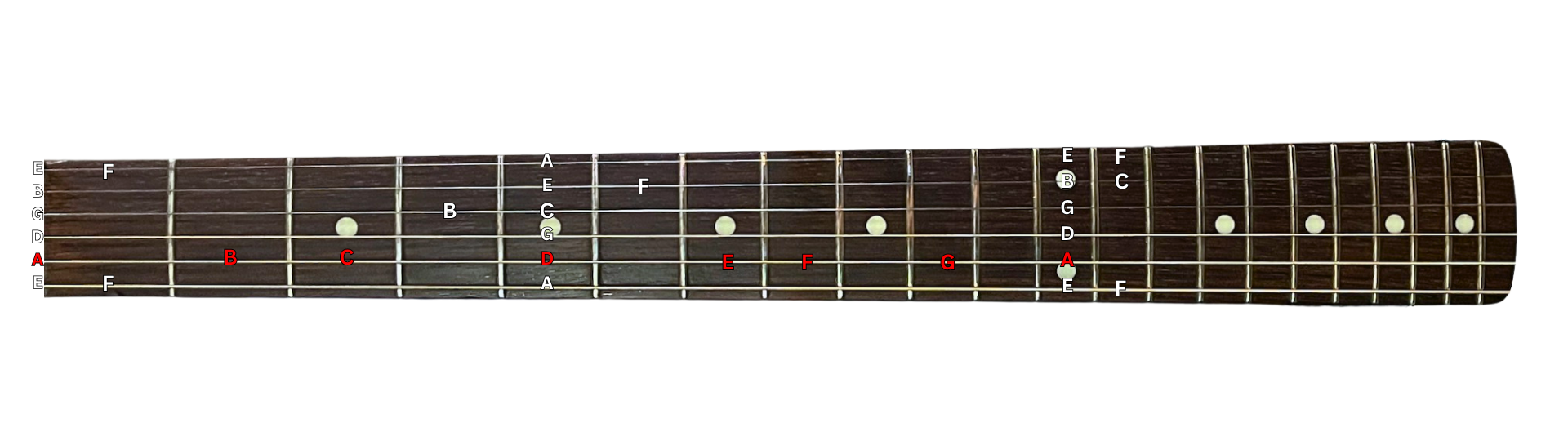
The accidentals are simply going to fill in the gaps. Let's first take a look at how this lays out on the piano.
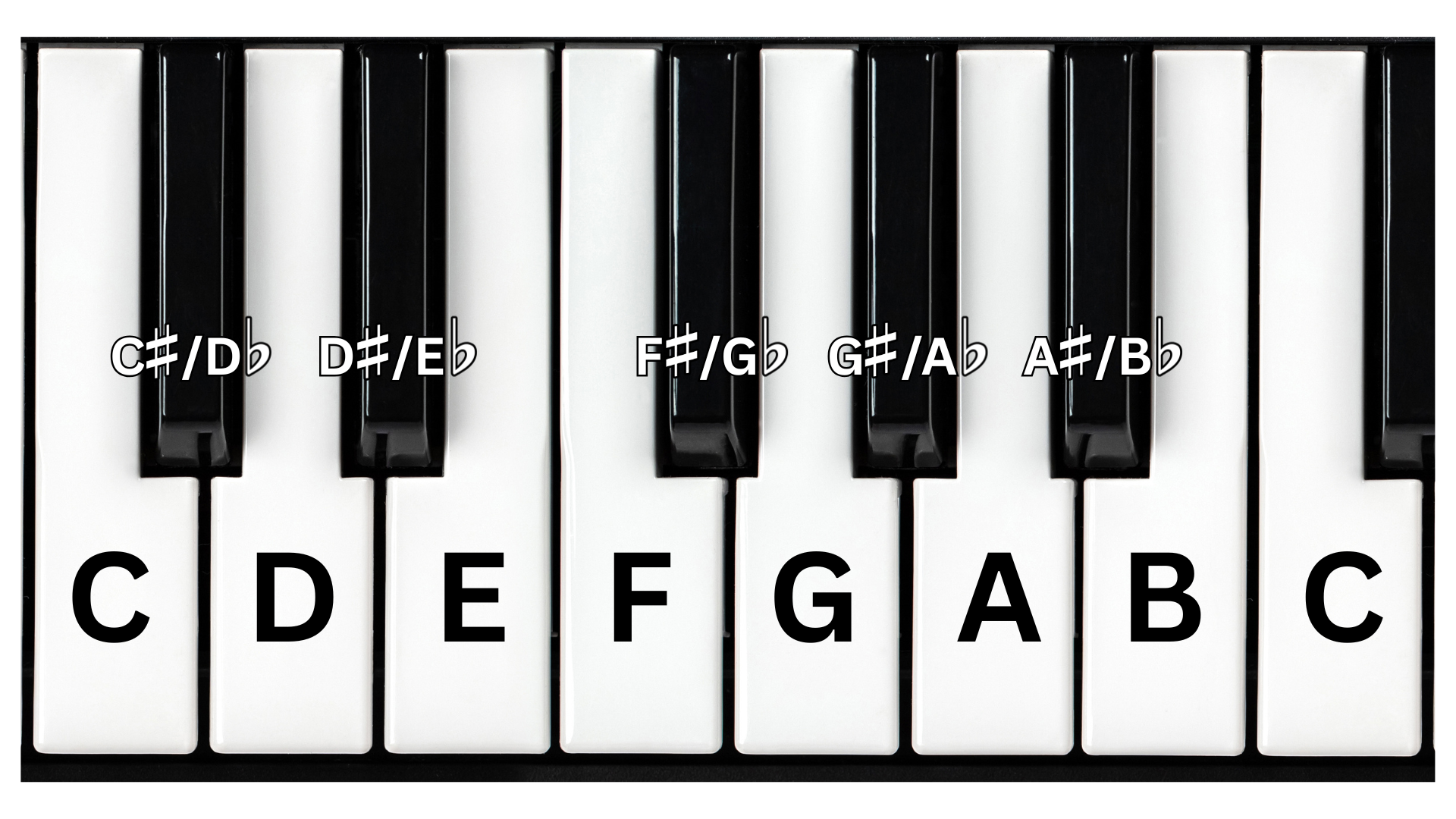
Notice that each of the black keys can be named as either a sharp or a flat. Context will tell you which to use in a given situation.
As a first step toward understanding the accidentals, we can say that if we are ascending (climbing the notes from left to right on the piano) we will use the sharps. If descending (right to left), we'll use the flats.
For our purposes, we're going to put both into the unnamed frets between the natural notes.
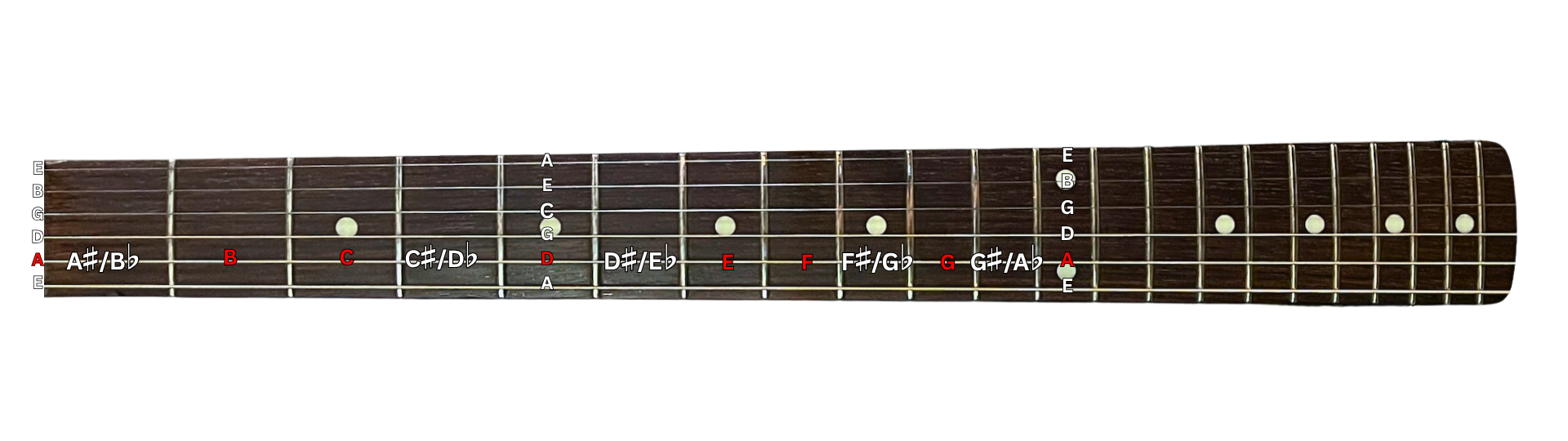
You should be able to see that by memorizing the names of the notes of the open strings, the fifth fret (from relative tuning) and the twelfth fret (an octave above the open strings), you have the sign posts to transfer the names of the notes on the A string to the rest of the fretboard.
Let's look at some examples.
Look at the twelfth fret on the A string. It's an A, which means that if we "copy and paste" the note names from the bottom of the string to the twelfth fret, we have the names for the entire string.
Notice that the fifth fret for both the low and high E strings is A. So "copy and paste" the note names from the A string to those points and you now know most of the notes of the E strings.
To get the rest of the notes from those strings, check this out.
Transfering the note names from the A string to the E string at the fifth fret will extend to the seventeenth fret. So to get the note names for the first frets of the E string, "copy and paste" everything from the twelfth fret and up, down to the open string.
If you do it correctly, you should find that the A from the seventeenth fret lands on the fifth fret.
Next steps:
Once you've gotten the hang of this I recommend going to the scales you know how to play and naming the notes. Once the relationships between the frets and the notes become clear, this will really start to stick.
You can also do the same with the chords you know and any songs. When you know the notes of the music you're playing, a whole new world of understanding opens up.