What Are Accidentals in Music? A Guitarist's Guide to Sharps, Flats, and Naturals
Aug 04, 2026
What are accidentals in music? If you've started learning note names or how to spell chords and scales, you've probably come across these symbols:
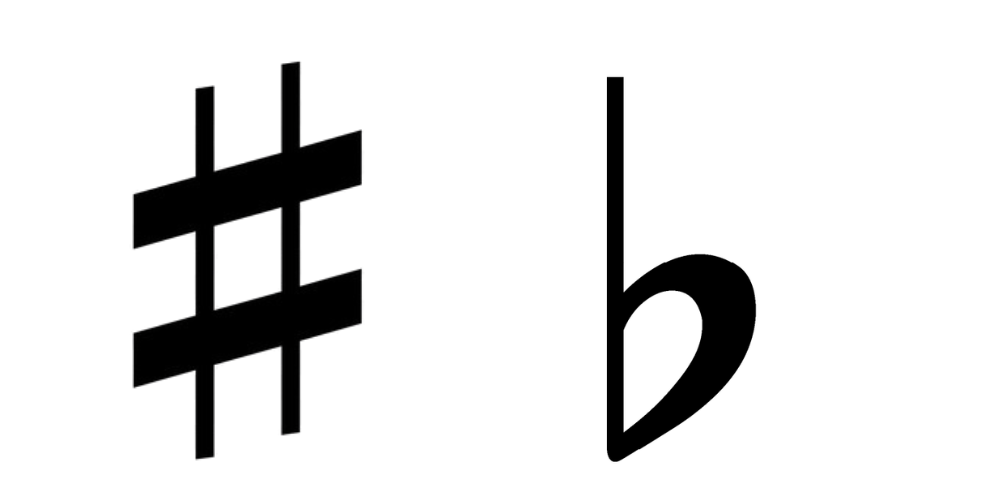
You may have also seen this one:

These symbols are collectively known as accidentals. While now isn't the time to explain why they're called that, I can assure you they're no accident.
If you've done a little research, you've probably learned that:
- A sharp raises a note by a half step.
- A flat lowers a note by a half step.
- A natural cancels a previous sharp or flat within the same measure.
At first, though, you might wonder:
"What does that actually accomplish?"
The answer is simple: accidentals allow us to organize notes, scales, chords, and keys into logical, recognizable patterns.
Without them, music theory—and the note names we rely on—would become much harder to understand and remember.
Let me show you what I mean. I'll use standard notation, but don't worry if you don't read music. The idea should still be easy to follow.
1. Scales
Here is the C major scale. Notice that it contains no accidentals.
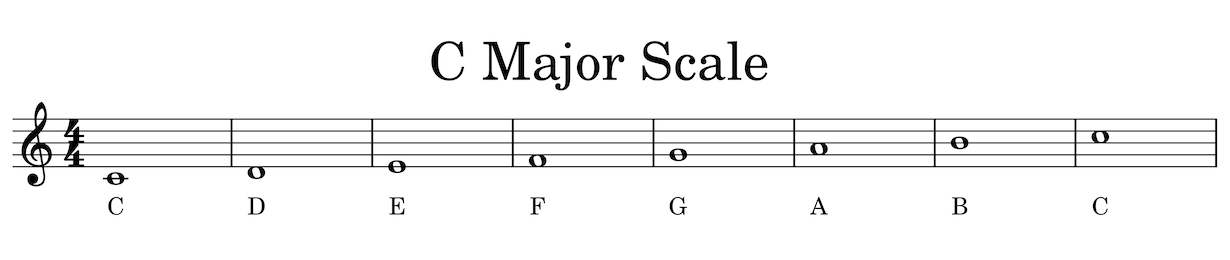
The note names are:
C – D – E – F – G – A – B – C
If you've seen my lesson on learning the fretboard, you'll recognize these as the seven natural notes in our musical system.
Over the years, I've heard people suggest that we should simply give each of the twelve notes its own letter name and eliminate accidentals altogether.
If we did that, the twelve notes might be named like this:
A B C D E F G H I J K L
At first glance, that might seem simpler.
But now our familiar C major scale wouldn't be C major anymore—it would be based on D, and its notes would be:
D – F – H – I – K – A – C – D
Not exactly easy to remember.
Now imagine memorizing twelve major scales like that.
Using accidentals instead keeps every major scale organized around the same seven letter names. Each scale contains one of every letter (A through G), while sharps and flats adjust the notes to create the proper major scale pattern.
Here's what the A major scale looks like:

Notice that all seven letter names still appear exactly once. The accidentals simply preserve the correct spacing between the notes so the scale sounds like A major.
That's a much more elegant system.
2. Chords
Chords benefit from the same idea.
Here are four qualities of a C chord: major, minor, diminished, and augmented.
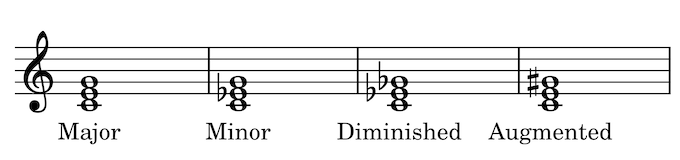
If you don't read notation, the note names in a C major chord from bottom to top are:
C – E – G
Notice that every one of these chord qualities is built from the same basic ingredients:
- C (the root)
- Some kind of E
- Some kind of G
The accidentals simply change one or more of those notes.
If every pitch had its own unique letter name, our C major chord might instead be called D major and be spelled:
D – H – K
A D minor chord would become:
D – G – K
The relationships between chord qualities become much harder to recognize because the note names themselves change instead of simply adding sharps or flats.
Accidentals preserve those relationships, making chords much easier to understand, memorize, and compare.
Summary
- Accidentals organize notes, scales, chords, and keys into logical patterns.
- There are seven natural note names (A, B, C, D, E, F, and G). Sharps and flats provide the remaining five pitches in our twelve-note system.
- Every major scale uses each letter name exactly once. Accidentals adjust the notes while preserving that pattern.
- Chords work the same way. Different chord qualities use the same letter names, while accidentals change specific notes to create major, minor, diminished, augmented, and other chord types.
Next Steps
Start learning how to spell the chords and scales you already know. There are plenty of good references available online.
As you study them, look for the patterns.
Which notes do the chords and scales have in common? Which notes change? Once you begin seeing those relationships, music theory becomes far more intuitive—and much easier to remember.